


03/03/2026 from Daily Jokes
#21879
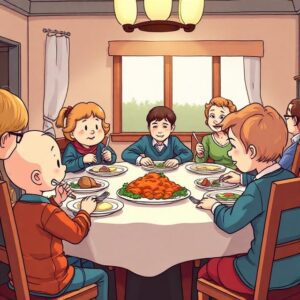
Everyone had gathered around the big dining table, plates neatly arranged and the smell of a home-cooked meal filling the room. The adults chatted softly while dishes were passed from hand to hand. Soon, a warm, heaping plate was set down in front of little Logan.
Without hesitation, Logan picked up his fork and eagerly dug in, clearly unable to resist the delicious aroma rising from his food.
“Logan,” his mother gently said, placing her hand near his arm, “wait until we say our prayer.”
Logan looked up, slightly puzzled but still chewing. “I don’t have to,” he replied matter-of-factly.
His mother raised an eyebrow. “Of course you do. At our house, we always say a prayer before we eat.”
Logan swallowed his bite and gave her a confident little smile. “That’s at our house,” he explained calmly. “But this is Grandma’s house… and she knows how to cook.”
For a brief moment, there was silence around the table — then laughter broke out as everyone realized the innocent logic behind Logan’s remark.
03/02/2026 from Daily Jokes
#21875

A curious little girl, wide-eyed and full of questions about the world, approached her mother one afternoon and asked, “Mom, how did the human race come about?”
Her mother smiled warmly, pleased with the thoughtful question. She gently explained, “God created Adam and Eve. They had children, and from them, all of humanity came to be.” The girl nodded, satisfied for the moment, and went on her way, turning the answer over in her mind.
A few days later, still pondering the mystery of human beginnings, she decided to ask her father the very same question. “Dad,” she said, “how did the human race come about?”
Her father leaned back thoughtfully and replied, “Well, many, many years ago, there were monkeys. Over time, through gradual changes, humans developed from them.”
Now thoroughly puzzled, the little girl tried to make sense of the two very different explanations. After thinking about it for a while, she went back to her mother and said, “Mom, I’m confused. You told me that the human race was created by God, but Papa said we developed from monkeys. How can both be true?”
Her mother paused for a moment, then gave a calm, knowing smile. “Oh, sweetheart,” she said gently, “it’s very simple. I told you about the origin of my side of the family, and your father told you about his side.”
And with that, the little girl finally understood — at least enough to stop asking questions for the day.
03/01/2026 from Daily Jokes
#21869

Once upon a time, there was a curious little girl with a mind full of questions about the world around her. One quiet afternoon, while sitting at the kitchen table with her mother, she looked up from her coloring book with wide, inquisitive eyes and asked, “Mommy, where did people come from? How did the human race actually begin?”
Her mother paused for a moment, a gentle smile gracing her lips. She chose her words carefully, wanting to provide an answer rooted in faith and tradition. “Well, my darling,” she said softly, “God created the very first man and woman, Adam and Eve. They had children, and their children had children, and that is how all of mankind came to be.”
The little girl nodded, satisfied with this clear and divine explanation. However, a few days later, while her father was reading the newspaper in the living room, the same question bubbled up in her mind again. She climbed onto his lap and asked, “Daddy, how did the human race come about? Where did the first people come from?”
Her father lowered his paper, adjusting his glasses as he considered the question from a more scientific perspective. “Well, sweetheart,” he began thoughtfully, “that happened a very long time ago. Originally, there were monkeys and apes. Over millions of years, we evolved and developed from them into the humans we are today.”
The little girl thanked him, but as she walked away, her brow furrowed in deep confusion. She spent the rest of the day trying to reconcile the two very different stories. One spoke of divine creation, while the other spoke of primates and evolution. The contradiction weighed heavily on her young mind until she finally decided she needed clarity.
She returned to the kitchen, where her mother was preparing dinner, and looked up at her with a troubled expression. “Mommy,” she said hesitantly, “I don’t understand. When I asked you, you told me that the human race was created by God. But when I asked Papa, he said we developed from monkeys. How can both of those things be true?”
Her mother stopped what she was doing and wiped her hands on her apron. She looked down at her daughter with a knowing twinkle in her eye and a calm, reassuring voice.
“Well, dear,” she replied smoothly, “it is actually very simple to explain. I was telling you about the origin of my side of the family, and your father was telling you about his.”
02/28/2026 from Daily Jokes
#21862

At her very first wedding, a curious little girl sat quietly beside her mother, taking in all the unfamiliar sights and sounds. The flowers were beautiful, the music was soft and romantic, and everyone seemed dressed in their very best. But what truly caught her attention was the bride walking gracefully down the aisle in a long, flowing white gown.
Leaning closer to her mother, she whispered innocently, “Why is the bride dressed in white?”
Her mother smiled and gently replied, trying to keep the explanation simple. “Because white is the color of happiness. It symbolizes joy and new beginnings. Today is supposed to be the happiest day of her life.”
The little girl nodded thoughtfully and sat back in her seat, clearly pondering this new information. After a few quiet moments of serious consideration, she turned back to her mother with another question, her eyes wide with curiosity.
“Then why is the groom wearing black?”
02/27/2026 from Daily Jokes
#21857

A man once owned a parrot unlike any other. This bird didn’t chirp sweet melodies or politely mimic household phrases. No, this parrot swore like a hardened sailor. He had a vocabulary so colorful and creative that he could rant for five full minutes without repeating a single curse word. It was almost impressive — if it hadn’t been so exhausting.
The problem was that the parrot’s owner was the complete opposite. He was a quiet, conservative, soft-spoken man who valued peace and order in his home. Every shrieked insult and string of profanity grated on his nerves. The neighbors were starting to notice. The mailman hesitated at the gate. Even the dog looked uncomfortable.
Day after day, the parrot’s language grew worse. Finally, one afternoon, after enduring yet another uninterrupted tirade of outrageous insults, the man snapped. He grabbed the parrot firmly and shouted, “QUIT IT!” while giving him a rough shake.
That was a mistake.
The parrot exploded with even louder, more inventive profanity, squawking and flapping in outrage. The man’s face turned red. “That’s it,” he muttered. “I’ll teach you.”
He stuffed the bird into a kitchen cabinet and slammed the door shut.
Inside, the parrot went berserk — scratching, clawing, banging, and screeching at full volume. When the man finally opened the cabinet door, the parrot burst out with a stream of insults so fierce and vivid it would have made a veteran sailor blush.
Now completely fed up, the man stormed to the freezer, yanked the door open, and tossed the parrot inside.
For a few seconds, the kitchen was filled with chaos — frantic squawking, furious flapping, and violent thumping against frozen food boxes. Then, suddenly, silence.
Total silence.
The man stood there, breathing heavily. A minute passed. Then another. The quiet stretched on, and his anger slowly turned into worry. Had he gone too far? Had he hurt the bird?
After several tense minutes, guilt got the better of him. He cautiously opened the freezer door.
To his surprise, the parrot calmly stepped out, climbed gently onto the man’s outstretched arm, and in a soft, respectful voice said, “I would like to sincerely apologize for the distress I have caused you. I assure you that from this moment forward, I will make every effort to improve my vocabulary and conduct myself with proper decorum.”
The man stared in disbelief. He couldn’t understand what had caused such a dramatic transformation.
The parrot tilted his head politely and added, “If you don’t mind me asking… what exactly did the chicken do?”