


10/11/2026 from Daily Jokes
#22761

Lady Penelope was a woman of immense wealth, impeccable taste, and absolutely zero empathy. As Christmas approached, she sat in her velvet-draped drawing room, sipping Earl Grey tea while her long-suffering maid, Martha, stood by with a notepad, ready to document the mistress’s charitable “generosity” toward the staff.
“Now, Martha,” Lady Penelope began, adjusting her pearl necklace with icy precision. “Let us discuss the Christmas presents for the help. What about Arthur, the butler?”
Martha hesitated, knowing her employer’s stinginess well. “Perhaps a nice set of crystal wine glasses, Madam? He has been with you for twenty years.”
Lady Penelope frowned icily, as if Martha had suggested giving the man a live tiger. “He doesn’t really need that, Martha. A butler never entertains; he serves. He’ll get a tie. A sensible, polyester blend. Next.”
Martha grimaced but kept her composure. “And what about Jenny, the young serving girl? She’s been working double shifts all month.”
Lady Penelope waved a dismissive hand. “She doesn’t really need a new dress. If she gets a fancy dress, she’ll only get in trouble or develop ideas above her station. We’ll get her another apron. She can use the old one for polishing silver.”
The conversation continued in this same vein of calculated miserliness. Martha’s patience was wearing thin, her knuckles white as she gripped the notepad. Finally, they reached the last name on the list: Martha’s own husband, George, who worked as the groundskeeper.
“I assume,” Martha said, her voice trembling slightly with suppressed rage, “that you want to get him something he really needs, Madam? Something practical?”
“Of course, Martha,” Lady Penelope replied, looking up from her magazine with a smug, self-satisfied smile. “I am nothing if not fair. What do you suggest for George?”
Martha looked her employer dead in the eye, dropped the pen, and said with perfect, deadpan clarity:
“Then how about three more inches?”
10/10/2026 from Daily Jokes
#22758

Jack, a sharp-suited New York attorney known for his discretion and high fees, picked up the phone to call his most important client,
Saul. Saul was a wealthy art collector with more money than sense and a portfolio that rivaled the Met Museum.
“Saul,” Jack began, his voice calm and professional, “I have some good news, and I have some bad news.”
Saul sighed heavily on the other end of the line. “Jack, honestly, I’ve had an absolutely awful day. The market is down, my caviar was warm, and my yacht needs polishing. So, for the love of God, let’s hear the good news first.”
Jack cleared his throat, choosing his words with extreme care. “Well, I met with your wife today regarding her recent ‘artistic acquisitions.’ She informed me that she invested only $5,000 in two very nice, large-scale portraits. And here is the kicker, Saul: she believes they will bring somewhere between $15 and $20 million at auction. And after reviewing the artist’s current market trends…
I think she could be right.”
There was a stunned silence on the other end. Then, Saul’s voice exploded with pure, unadulterated joy. “Holy cow! Well done! My wife is a brilliant business woman, isn’t she? You’ve just made my entire week, Jack! I feel like a new man. Now, I know I can handle anything. What is the bad news?”
Jack took a deep breath, adjusted his tie, and replied with gentle, devastating precision:
“The pictures are of you and your secretary.”
10/09/2026 from Daily Jokes
#22752

Forrest Gump stood before the magnificent, pearl-encrusted gates of Heaven, his hands clasped politely behind his back. Saint Peter, holding a golden clipboard and looking slightly weary from centuries of administrative work, greeted him with a warm smile. “Ah, welcome, Mr. Gump. We’ve been anxiously awaiting your arrival. Your life was… certainly unique.”
Forrest looked intently at the swirling clouds and the golden light, not quite sure what to make of the scene in front of him. He gave a polite nod.
“Forrest,” Saint Peter began, adjusting his spectacles, “before I can let you into Heaven, I need you to answer three simple questions to verify your wisdom. Would that be alright?”
Forrest nodded again. “Yes, sir.”
“Okay, Forrest,” Saint Peter said, tapping his pen. “First question: How many seconds are in a year?”
Forrest thought for a moment, his brow furrowing in deep concentration. Then, he looked up and confidently answered, “Twelve.”
Saint Peter blinked, completely befuddled. “Twelve?! You believe there are only twelve seconds in a entire year? Please explain your reasoning.”
Forrest shrugged, his expression perfectly earnest. “Well, there’s January 2nd, February 2nd, March 2nd, April 2nd…”
Saint Peter held up a hand, stopping him mid-list. He rubbed his temples, realizing the sheer, linguistic cleverness of the answer. “Okay, I suppose you’re technically correct. That will do.” Forrest cracked a small, proud smile.
“Alright, Forrest,” Saint Peter continued, trying to regain his composure. “Second question: How many days of the week begin with the letter ‘T’?”
Forrest thought for a moment, counting on his fingers. He furrowed his brow a bit, then replied, “Four.”
Saint Peter was again taken off guard. “Four?! How on Earth do you get four? There’s Tuesday and Thursday… that’s only two!”
Forrest looked Saint Peter dead in the eye, his voice steady and logical. “Well, you got Tuesday, Thursday, Today, and Tomorrow.”
Saint Peter nearly fell over with incredulity. He stared at Forrest, who just stood there, waiting patiently. “Okay,” Saint Peter sighed, checking a box on his clipboard. “I suppose that’s also technically correct.” Forrest’s smile grew wider.
“Ok, Forrest, lastly,” Saint Peter said, deciding to go for the ultimate theological test. “What is God’s real name?”
Forrest thought about the question. His brow wrinkled, a little bit of sweat began to form on his forehead. The stakes were high. Then, Forrest’s eyes grew wide, and he said with booming, gospel-level authority:
“Andy! God’s real name is Andy!”
Saint Peter slammed his hands down onto the podium, his jaw dropping. “ANDY?! How, please tell me, did you arrive at ANDY?!”
Forrest looked Saint Peter dead in the eye, tilted his head, and said:
“Like the song says, ‘Andy walks with me, Andy talks with me…'”
Saint Peter froze. He slowly lowered his head, sheepishly looked at Forrest, and whispered:
“Welcome to Heaven, Mr. Gump.”
10/08/2026 from Daily Jokes
#22748
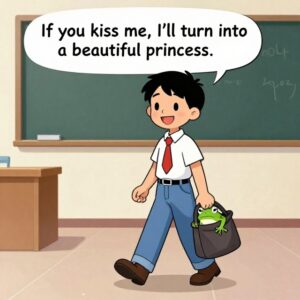
It was a crisp Tuesday morning on the university campus, and Arthur, a third-year engineering student with dark circles under his eyes and a backpack full of textbooks, was rushing to his Thermodynamics lecture. He was already ten minutes late, his coffee was cold, and his brain was currently calculating the structural integrity of his own sanity.
As he hurried across the quad, he nearly stepped on a small, green frog sitting squarely in the middle of the sidewalk. Arthur stopped, adjusted his glasses, and looked down. To his absolute astonishment, the frog looked up, cleared its throat, and spoke in a clear, melodic voice.
“Excuse me, young man,” the frog said politely. “If you would be so kind as to kiss me, I will turn into a beautiful princess.”
Arthur blinked. He looked at his watch. He looked back at the frog. A slow, pragmatic smile spread across his face. Without saying a word, he gently scooped the frog up, placed it carefully inside his zippered side pocket, and kept walking toward the lecture hall.
A few minutes later, as Arthur was navigating the crowded hallway, he heard a muffled voice coming from his bag. He paused, unzipped the pocket, and pulled the frog out again.
The frog looked him in the eye and raised the stakes. “Listen, if you kiss me, I’ll not only turn into a beautiful princess, but I’ll also go on a romantic date with you!”
Arthur considered this for a moment. He thought about the cost of dinner, the time commitment, and the inevitable awkward small talk. He smiled politely, put the frog back in his bag, zipped it up, and kept walking.
After another minute, the frog was practically screaming from inside the canvas. Arthur sighed, stopped by a water fountain, and took the frog out once more.
“Okay, okay!” the frog pleaded desperately. “If you kiss me, I’ll turn into a princess, we’ll go on multiple dates, I’ll introduce you to my wealthy parents, we’ll get married, buy a house, and who knows what amazing things will happen after that!”
Arthur listened intently, nodding along as if reviewing a complex project proposal. Then, he smiled warmly, opened his bag, and started to put the frog back inside.
“WAIT!” the frog cried out, hanging onto the edge of the zipper. “Why won’t you kiss me?! This is a literal fairy tale opportunity!”
Arthur looked down at the amphibian, shrugged his shoulders, and replied with perfect, deadpan logic:
“Look, I’m incredibly busy with school right now. I have three midterms this week, a lab report due tomorrow, and zero free time for a girlfriend. However, a talking frog? That is actually really cool.”
10/07/2026 from Daily Jokes
#22745

It was a bright, sunny Tuesday morning at “Timber Town Lumber,” and the yard was bustling with contractors and DIY enthusiasts.
A dusty, beat-up pickup truck rumbled through the gates and parked haphazardly near the loading dock. Two men, both wearing hard hats that looked like they’d seen better days, hopped out and marched into the main office.
One of them, a burly guy named Dave, leaned heavily on the counter and addressed the young, bespectacled clerk. “Hey there, buddy. We need some four-by-twos.”
The clerk blinked, adjusting his glasses. He knew these guys were probably just confused by the standard naming conventions. “You mean two-by-fours, don’t you?” he asked politely.
Dave frowned, looking genuinely perplexed. “Hold on a second. Let me go check.” He turned around, walked back out to the truck, and had a brief, intense whispered conversation with his partner. A few moments later, he returned to the counter, nodding confidently. “Yeah, you’re right. I meant two-by-fours. My bad.”
The clerk smiled, relieved that the confusion was cleared up. “No problem at all. Alright, how long do you need them?”
Dave paused. His brow furrowed in deep, philosophical concentration. He tapped his chin, looked up at the ceiling tiles, and then looked back at the clerk. “That’s a good question. I’d better go check.”
He turned around again, walked back out to the truck, and disappeared for a full five minutes. The clerk waited patiently, assuming they were measuring the dimensions of a specific beam or checking a blueprint.
Finally, Dave came back into the office, looking very serious. He leaned in close to the counter and said:
“A long time. We’re building a house.”